

The latest news we’ll cover:
Please fasten your belts!
Ethlabs Puts Quantum Safety Ahead of Faster Blocks
Research group Ethlabs withdrew its faster-block proposal from the planned 2027 Hegotá upgrade, urging core developers to pull Ethereum’s post-quantum security forward from the current 2028 target to 2027. The group cited rising risks from AI-driven bug hunting and the outside chance of an AI-led mathematical breakthrough that weakens today’s cryptography.
Account abstraction is the vehicle. Ethlabs wants Hegotá built around Frame Transactions, the already planned upgrade that lets accounts choose how they approve payments, including quantum-resistant signatures, and natively swap out exposed keys, though wallets would need to update and holders would still have to switch signing methods.
Vitalik Buterin weighed in on the cost problem. Post-quantum signatures run from about 1,000 to 6,000 bytes against today’s 65, so storing them all would eat block space and raise fees, and he said he has gone from thinking leanPCS was “total bull” to being a “total bull” on it.
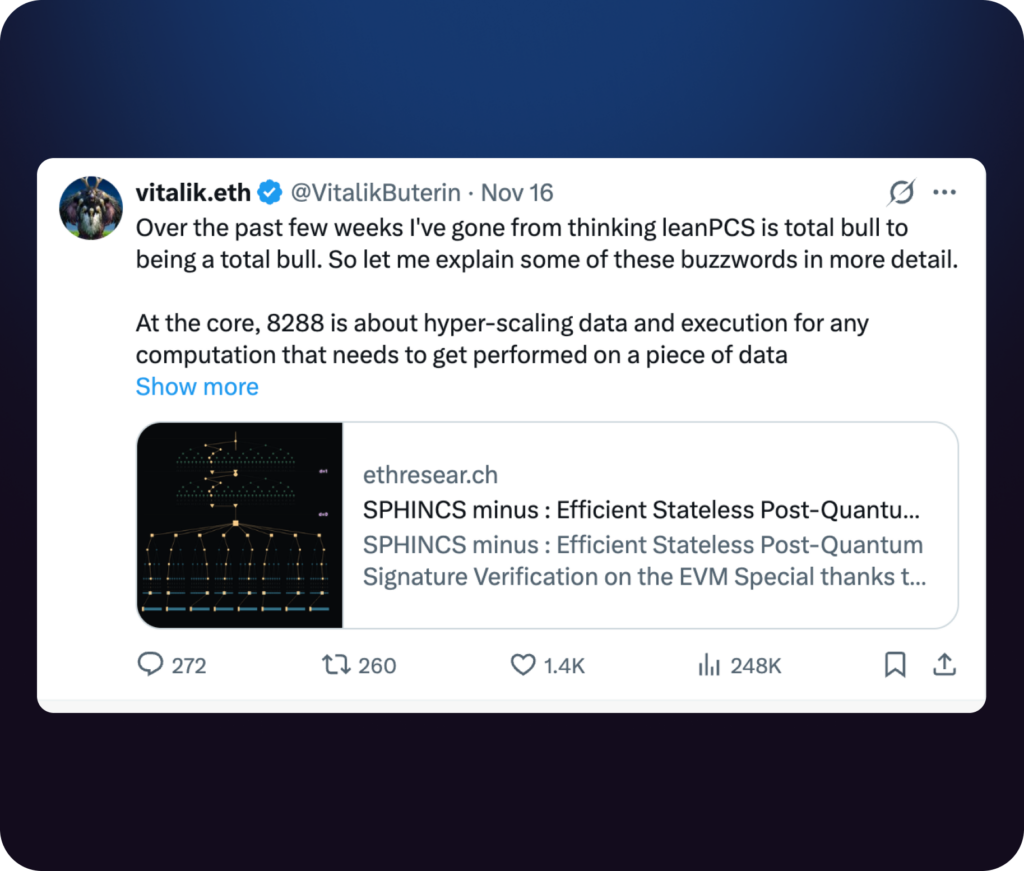
The idea is aggregation. Under EIP-8288, computers combine many signatures and proofs into one shared proof per block, so Ethereum keeps the payment instructions and enough to verify that proof without storing every bulky signature, which also makes stronger privacy more affordable. It remains a draft with an unfinished reference implementation and no launch date.
A Claude Agent Goes on Trial
A Devcon demo put the agent-payments stack to the test by placing a real Claude agent on trial on Celo mainnet, in a single terminal. The agent registers an ERC-8004 identity, earns 0.10 USDT, and pays for an API through x402, combining on-chain identity with agent payments in a live flow.
Then it gets burned on purpose. The agent buys a report from a provider with no reputation and receives junk, which is exactly the failure mode that makes trusting a spending agent hard.
The resolution is where it gets interesting. The agent opens a dispute through Kleros, and the ruling is written back as ERC-8004 reputation feedback, so a bad counterparty’s record follows it on-chain.
Every step leaves evidence. The transactions, the feedback entries, and the agent’s own memory and receipts live on Swarm, a decentralized storage network, so no single server can alter or remove them. It is a concrete end-to-end picture of how identity, payments, and reputation combine to make autonomous agents accountable.
Phylax and Titan Add Circuit Breakers to Ethereum
Phylax and Titan Builder launched circuit breakers on Ethereum, letting any application define risk outcomes it refuses to accept. Titan Builder, which produces roughly half of Ethereum blocks, checks those rules during block construction and excludes state changes that violate them before they settle.
The point is to stop single-block attacks. A vault team can write a Solidity rule, for example that no transaction may remove more than half the assets under management, and a withdrawal that breaks it is left out of the block rather than caught after the money is gone.
Sovereignty is built in. Only the protocol can authorize rules for its own contracts, the rules can only block transactions and cannot create or alter state, and Titan merely runs the check, with a median policy evaluation of about 255 microseconds. Nothing changes at Ethereum’s protocol level, and the system is open to any builder.
The model adds another layer of protection around transaction execution. Applications define their own risk limits, and participating builders can enforce those limits before a state change settles on Ethereum.
The Transit Authority Maps Wallet Data Leaks
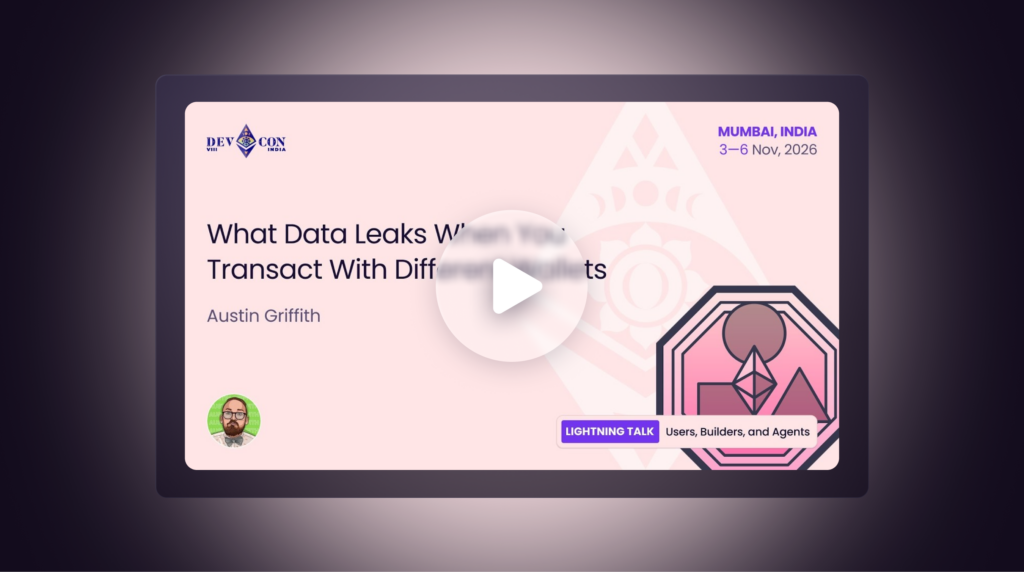
A Devcon project called the Ethereum Transit Authority, presented by Austin Griffith, maps what data leaks when you transact with different wallets. Its interactive site draws each common action, a send, swap, approval, bridge, or on-ramp, as a transit map of every network request the wallet makes.
The maps make the dependencies legible. Each flow lists its stations and requests and shows which third parties, like RPC providers, indexers, and price APIs, see your address and activity along the way, with some wallets touching twenty or more stops for a single swap.
It also points to possible fixes. Sections rank access vectors by reach and exposure, show how much a given company can see across all flows, and spell out what pointing a wallet at your own node removes and what still leaks anyway.
This is the privacy counterpart to the account abstraction work. Smart accounts and native AA change how transactions are authorized and paid for, but the metadata a wallet leaks to infrastructure is a separate layer, and this project is a clear, concrete audit of where that data goes and where there is no escape today.
Start exploring Account Abstraction with Etherspot!
- Learn more about account abstraction here.
- Head to our docs and read all about Etherspot Modular SDK.
- Skandha — developer-friendly Typescript ERC4337 Bundler.
- Arka — an open-source Paymaster Service for gasless & sponsored transactions.
- Explore our TransactionKit, a React library for fast & simple Web3 development.
- Follow us on X and join our Discord.
❓Is your dApp ready for Account Abstraction? Check it out here: https://eip1271.io/
Subscribe to Etherspot’s All About Abstraction Newsletter!
Get In Touch:
Website | X | Discord | Github | Telegram | Developer Portal
Powered by Etherspot